


From page to Screen Part 2; The 10 Best Film Adaptations

I mean, this is harder, right? After posting about my ten favourite book-to-TV adaptations a couple of months ago, I got into a fair few... let's say, discussions... with friends and colleagues about my list.
'What about Normal People?' some asked?
'Bad Monkey on Apple TV was excellent!' others stated.
'I'd have added Morse,' James McShane rightly suggested to me on social media.
'I thought One Day on Netflix was amazing,' said a friend.
'The Witcher!'
'The Queen's Gambit!'
'The Wire, you idiot!' [yeah, that's my bad!]
And so on...
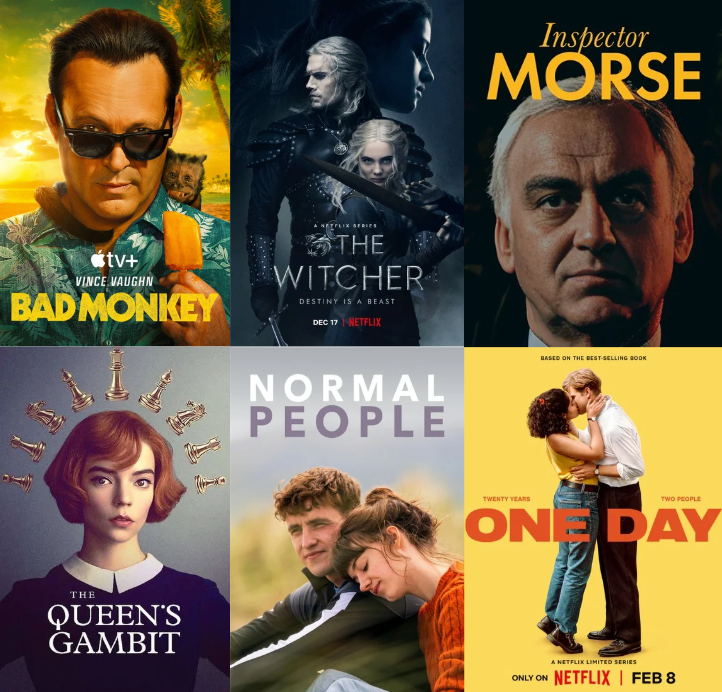
None of these people are wrong, because all of those shows are great [well, not The Witcher, but maybe that's just me. And sorry Dad, I'm not having All Creatures Great and Small either]. That's the thing about opinions though, isn't it? They're like arseholes; everyone's got one, and no one thinks theirs stinks.
"That's the thing about opinions, They're like arseholes; everyone's got one, and no one thinks theirs stinks."
However, I found choosing that list was a walk in the park compared to choosing this one. The film industry has never been shy in co-opting a successful book/comic/video game/toy line for its own ends. Many of those finished films end up being pants [that's a whole other list, featuring more than one Transformers film], but so many also end up as brilliant versions of equally brilliant existing intellectual property, and often that IP is a book.
I already knew a lot of films began life as books, but when I started looking into this more deeply, I was surprised at just how many great films there are which I hadn't realised were originally books;
Die Hard [based on the 1979 thriller Nothing Lasts Forever, by Roderick Thorp]
Mrs Doubtfire [inspired by the 1987 novel Madame Doubtfire, by Anne Fine
Shrek [based on the children's picture of the same name by William Steig]
Who Framed Roger Rabbit [based on the novel, Who Censored Roger Rabbit?, by Gary K. Wolf]
Anyway, I think I'm just stalling for time because I still can't make up my mind. But, for what it's worth, below is my list - in order of the year of release - of my ten favourite films adapted from books. Feel free to tell me I'm wrong. You won't be the only one.
All Quiet on the Western Front [1930 & 2022]

We start with an anomaly; one book, two films. All Quiet on the Western Front is a powerful, emotional, quietly brutal and semi-autobiographical book by Erich Maria Remarque that was published all the way back in 1928, and based on Remarque's experiences of the First World War. The first movie adaptation it spawned was in 1930, a US-made film about German youths and their experiences of the war. I saw it at school when I was about 11, which seems odd to think now as it's pretty violent for its time and (as you might expect) incredibly bleak. But it was also deemed important; not just by my school, but by the world at large, and certainly America, which allowed the violence to remain because the subject matter was important.
"A powerful, emotional, quietly brutal and semi-autobiographical book by Erich Maria Remarque."
Then, in 2022, director Edward Berger released his own version of the film on Netflix and, like the 1930 iteration, it's a powerful, gritty, grim depiction of the brutality of war, but also a study of friendship, camaraderie, naivety, nationalism and the depths to which humans can descend. I was lucky enough to interview Edward Berger for work not long after the release of his film, and both his and the 1930 version are virtuoso films that are a tough but important and impactful watch.
It's A Wonderful Life [1946]

Full disclosure; this is my favourite film. Ever. And so, because it's my list, this sneaks onto here by dint of the fact that the film is adapted from a 1943 short story titled The Greatest Gift, by Philip Van Doren Stern. Stern's story was only a little over 4,000 words long and, unable to find a publisher for it, the author printed and distributed copies himself - roughly 200 - as Christmas cards. Film studio RKO, then director Frank Capra, bought the rights to the story and the rest is Jimmy Stewart history.
"A story about one man's impact on the people around him."
The film is a beautiful and heartfelt story about family, friends, kindness, honour and why success can be measured in many different way. Ultimately, it's an emotional story about one man's impact on the people around him.
Jaws [1975]

The poster is iconic, and the film changed the landscape of cinema as the first movie to release 'wide' across the US rather than incrementally increasing its presence over weeks and, sometimes, months. In doing so, Jaws became the first ever film to earn the title of 'blockbuster', and also paved the way for a generation of people scared of the water.
"Changed the landscape of cinema."
Steven Spielberg was only 26-years-old when he began filming Jaws, and though a lot of Peter Benchley's original novel was excised from the film, making it a leaner and more shark-focussed feature, it is a seminal 70s film which broke box office records on its release, changed the Hollywood studio system and ushered in a new era of filmmakers.
Goodfellas [1990]

"As far back as I can remember I always wanted to be a gangster." So goes the opening voiceover to Martin Scorsese's seminal film about the mafia. Based on crime reporter Nicholas Pileggi's 1985 book, Wiseguy: Life in a Mafia Family, that chronicled the life of mobster-turned-informer Henry Hill, Goodfellas is a brilliant glance into life as a mobster in the 70s and 80s; the scams, the violence, the friendships, the feuds and, eventually, the drug-induced paranoia. It's a brilliant film, with fantastic performances from Ray Liota, Joe Pesci, Robert De Niro and Lorraine Bracco.
The Silence of the Lambs [1991]

Another animal-based film. While Jaws made us afraid of sharks, The Silence of the Lambs failed to instil in us the fear of sheep, but did make us petrified of Anthony Hopkins. Thomas Harris's book, which I only read after seeing the film, is a tight, creepy and harrowing book with a brilliant villain... even though the infamous Hannibal Lecter isn't the book's main villain, that being Buffalo Bill.
On the page, Lecter is a scary and fascinating character but, in Jonathan Demme's 1991 film, Hopkins' portrayal of the sociopathic cannibalistic serial killer is brilliantly unnerving, earning Hopkins an Oscar for his performance, even though he's only on screen for around 20 minutes... but what a twenty minutes!
Schindler's List [1993]

Hannibal Lecter may be one of cinema's most enduring bad guys, but he pales into comparison against Amon Göth, the SS officer played by Ralph Fiennes in Schindler's List, because Göth wasn't a character pulled from an author's imagination, but a real person. Steven Spielberg's black and white masterpiece is adapted from Thomas Keneally's Booker Prize-winning 1982 book Schindler's Ark, and follows another real person, Oskar Schindler, a Nazi party member and businessman who helped save the lives of 1,200 imprisoned Jews during World War Two.
"A harrowing, heartfelt and historically important piece of cinema."
That another Spielberg film [and another book adaptation], Jurassic Park, a more traditional, popcorn-friendly blockbuster, was released in the same year as Schindler's List highlights the director's
range, and while Jurassic Park will rightly be remembered as another brilliant blockbuster that ushered in the era of CGI, Schindler's List is a harrowing, heartfelt and historically important piece of cinema.
The Shawshank Redemption [1994]

From one Steven to another, differently spelled, one. Stephen King's 1982 novella, Rita Hayworth and Shawshank Redemption, was published in Different Seasons, a collection of four King novellas. Before the Frank Darabont-directed film came out, King's novella was likely not one of his best-known works but, after the film's release, it gained the attention and praise it deserved.
"Sad, uplifting, brutal and inspiring."
That being said, the film itself was not regarded as a staple of 'Best Ever Movie' lists that it now frequents, being largely ignored by audiences when it was first released despite critical praise, earning only $16 million during its initial original theatrical run. However, the film received a slew of award nominations and the then burgeoning video and DVD rental market saw the film reach new audiences and new appreciation.
Watching The Shawshank Redemption now, it's hard to understand how it wasn't an immediate hit. The performances are uniformly great - especially the main characters of Andy Dufresne and Ellis 'Red' Redding, played by Tim Robbins and Morgan Freeman respectively - and the story is a slow-burn tale of a man forced to survive a situation he is ill-prepared for. It's sad, uplifting, brutal and inspiring, and deserves its place on all those Best Movie lists.
Trainspotting [1996]

Irvine Welsh's debut novel, released in 1993, is a bold, visceral, often shocking tale of a group of friends in Leith, Scotland. Written in phonetic Scottish/English, which took me a little while to get my head around when I first read it at university, the book pulls you into the characters' world of drugs, alcohol, sex and 'fuck you' attitude to life. The book was an immediate cult hit in the Britpop-obsessed 90s, and Danny Boyle's film adaptation only cemented those characters and that story in popular culture.
"The magical realism [and surrealism] is stunningly effective."
Dead babies on ceilings, carpet-lined coffins into which people sink, and putrid toilets into which one character falls, the magical realism [and surrealism] of the film is stunningly effective at showing us the edge - of poverty, health, legality, reason - on which Renton, Begbie, Sick Boy et al live. The film's pulsating soundtrack - Iggy Pop, Underworld, The Velvet Underground - is still one of the best around, and Trainspotting is a film that'll live with you for a long time, even if it's not one you initially enjoy.
American Psycho [2000]

We've already had a few psychopaths on this list - Amon Göth, Hanibal Lecter, Joe's Pesci's Tommy DeVito in Goodfellas - and here's another one. Bret Easton Ellis's Patrick Bateman caused outrage as the main character of Ellis's 1991 novel, American Psycho. The book was banned in some countries and sold shrink-wrapped in others, as Ellis tells us the story of the young, rich, late-80s yuppie, Bateman, his stylish but empty life, and his series of increasingly brutal murders.
Like the book, the film is a deconstruction of the shiny, soulless lifestyle of our Wall Street banker 'hero', and both the book and film play with our understanding of what is really happening, whether Bateman is a reliable narrator, and whether the events he describes actually happen.
Christian Bale's performance as the shallow, egotistical and narcissistic Bateman is brilliant, and the simple fact that such a contentious book made it to the screen is an achievement in itself. That it retains the book's [very] dark humour and political and social commentary, while being engaging and stylish means it's an adaptation that's definitely one to watch.
The Road [2010]

God! It's tough going, isn't it? A relentlessly bleak vision of the future, one decimated by an unnamed, cataclysmic event, and through which a father and son try to navigate their way north to south. The scorched environment, the lack of food and, more specifically, other people provide constant threat to the pair's journey, in Cormac McCarthy's 2006 novel. The book is almost like a car crash on the other side of the road; you don't really want to know what's happened, but you can't help but look.
John Hillcoat's film is no different; harsh, desolate, intimidating, horrifying. But the fact that a father and son's bond remains so strong despite the potential futility and danger of their journey is at the heart of both book and film. It's also a visually powerful warning of where we could be headed if humans don't get their act together.
Honourable Mentions
Gone With the Wind [1939]
One Flew Over the Cuckoo's Nest [1975]
Forrest Gump [1994]
Fight Club [1999]


Comments